
STEREOGRAPHY
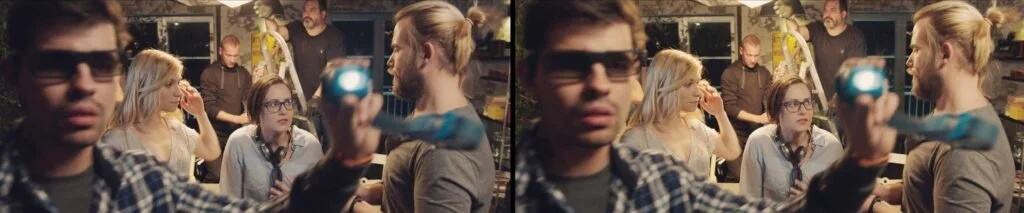
Stereoscopic filming is superior to 3D conversion qualitatively and economically. Significant amount of money and time can be saved and higher quality can be achieved with a hybrid approach, where only those parts are converted that are creatively, technically, or economically more favorable due to special artistic requirements, difficult shooting conditions, or dominance of VFX.
My personal feeling is contrary to what people believe a 3D movie ought to be, a technically advanced movie, which is spectacle or action. In this media, what you get most, an advantage, is an INTIMACY, the way you engage, the SYMPATHY, with the character (…) I know it’s a tough sell, against convention.
Ang Lee, The Independent, February 2017
Scientific studies demonstrate that stereoscopic images amplify the emotional response of the viewer to facial expressions.[1] Experiments have shown that the immersive nature of stereoscopic 3D film creates an emotionally more engaging experience, shortens reaction times, improves cognitive processing and concentration.[2] As Martin Scorsese put it, 3D film “immerses you in the story more. I saw audiences care about the people more.” The emotional response of the viewer is essential for the art of cinema and for the entertainment industry. We believe that the demand for stereoscopic content will increase with the development of display technology. We know that stereoscopic motion picture acquisition is the most straighforward and efficient technology to create high quality live action volumetric content for entertainment.
Sources: [1] Jussi Hakkala, Jari Kätsyri, and Jukka Häkkinen: Stereoscopy Amplifies Emotions Elicited by Facial Expressions, 20 Nov 2015 [2] Patrik Fagan: Heart-racing 3D films can make children ‘smarter’ in the short term, Engineers Journal, 14 June 2016